

Scroll through almost any marketing blog and you’ll quickly find an article titled “Is direct mail marketing dead?” The better question is: what role should direct mail play now that digital channels are cheaper, faster, noisier, and easier to automate?
Direct mail still works when it does a job that email cannot: earning attention in the physical world, reaching people outside the inbox, and making high-value messages feel more considered. But the future of direct mail is not bulk mail versus email. It is targeted, measurable, and connected to the rest of the customer journey.
In this article, we'll outline where direct mail marketing is headed: CRM-triggered campaigns, better attribution, AI-assisted personalization, QR and URL tracking, handwritten and hybrid formats, and offline touchpoints inside sales, retention, ABM, and eCommerce workflows.
Direct Mail vs Email
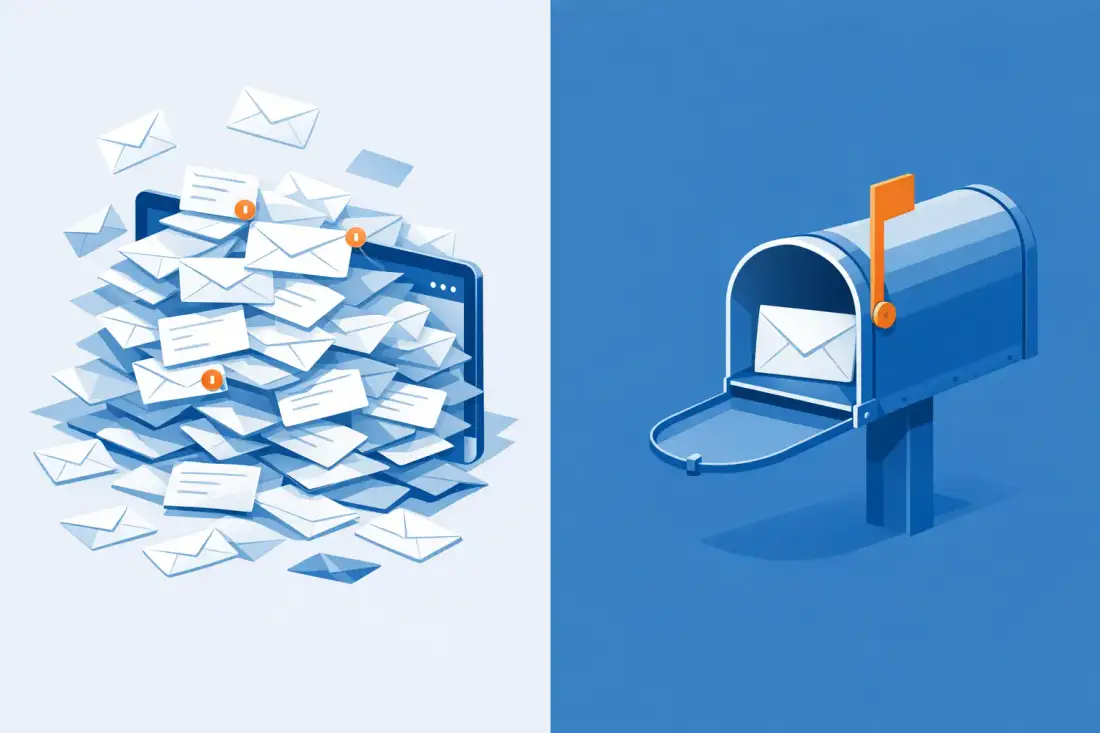
Email is still essential. It is fast, low cost, easy to test, and useful for operational communication. But because email is so easy to create, most teams now compete in an inbox full of automated lifecycle messages, AI-assisted outreach, newsletters, discounts, and follow-ups.
Direct mail has the opposite constraint. It costs more, takes more planning, and cannot be sent to everyone cheaply. That is exactly why it can work: the physical format signals selectivity.
Use email for speed and volume. Use direct mail when attention, trust, or relationship context matters more than immediate scale.
Response rates depend on audience warmth and intent
The strongest direct mail campaigns are not just “mail instead of email.” They are better targeted, better timed, and easier to measure.
JICMAIL's 2025 Response Rate Tracker reported average response rates of 7.2% for warm direct mail campaigns, 0.9% for cold direct mail, and 0.5% for door drops.
That distinction matters. A warm customer, active prospect, donor, or known account is not the same as a cold household. The future of direct mail is more likely to come from better audience selection than from treating mail as a broad replacement for digital advertising.
For more on measurement, see our guide to direct mail attribution.
What is changing in direct mail marketing?
1) CRM-triggered direct mail
Direct mail is moving from campaign calendars to customer signals. Instead of sending one batch to a static list, teams can trigger mail when a prospect books a demo, a customer reaches a renewal window, a VIP buyer crosses a loyalty threshold, or a donor gives again.
For implementation ideas, read CRM-triggered direct mail workflows.
2) AI-assisted personalization
AI can help teams summarize account context, draft message variants, and adapt copy by industry or trigger. But direct mail needs human judgment because mistakes are expensive and visible. The best workflow is AI-assisted, human-approved, and constrained by clear templates.
3) Better attribution
Modern direct mail can be measured with campaign IDs, QR codes, personalized URLs, CRM events, matchbacks, and holdout groups. The goal is not to prove every order came directly from a scan. The goal is to understand whether the mailed cohort performs better than a comparable unmailed cohort.
For practical tracking steps, see How to track direct mail marketing campaigns.
4) Handwritten, printed, and hybrid formats
The future is not one format. Printed mail works for reach. Handwritten mail works for high-value moments. Hybrid campaigns can combine the two: printed mail for awareness, then handwritten notes for engaged accounts, repeat customers, donors, or late-stage opportunities.
Use the printed vs handwritten vs hybrid format selector if you need to choose the right format by audience, cost, and intent.
5) Offline touchpoints in an AI-saturated inbox
As digital outreach gets easier to automate, physical mail can become more valuable precisely because it is harder to ignore. This is especially true for relationship-led campaigns: ABM, customer success, fundraising, real estate follow-up, eCommerce retention, and financial services.
The next step is not to send more mail to more people. It is to send better mail to the right people at the right moment.
If you want to make direct mail part of a measurable sales, retention, or customer campaign, Scribeless can help you create personalized handwritten direct mail with templates, automation, tracking, and fulfillment.
Want to build direct mail into your growth workflow? Book a campaign consult


